


Resumen:
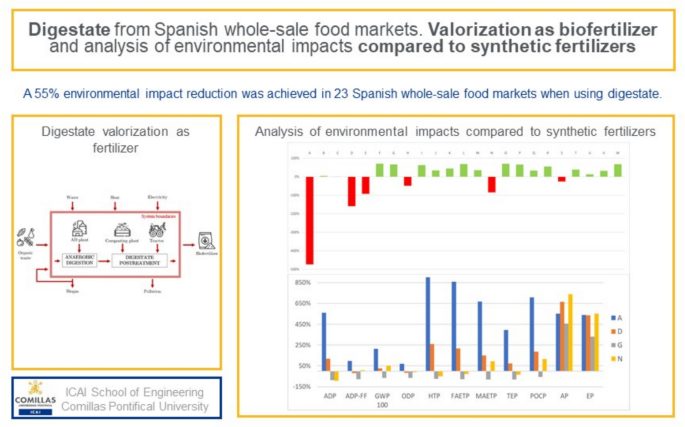
This study presents a comprehensive environmental impact assessment of biofertilizers from digestate in Spain’s 23 most extensive food markets using life cycle analysis. Eleven impact categories were evaluated. Results revealed significant variations in impacts across food markets, primarily due to differences in infrastructure sizing and energy self-sufficiency. Markets with appropriately sized anaerobic digestion facilities and energy self-sufficiency demonstrated significant environmental benefits, resulting in emission savings in 9 of the 11 impact categories assessed, except acidification and eutrophication. As a representative case of the markets with properly sized anaerobic digestion infrastructure and energy self-sufficiency, Market G as a representative market achieved up to 86% reduction in abiotic depletion and over 75% in toxicity categories. However, four food markets with either oversized or undersized infrastructure exhibited lower benefits, with Market A showing no advantages over synthetic fertilizers. In addition, the acidification and eutrophication categories posed challenges for all markets due to ammonia emissions during composting; in these impact categories, the values of biofertilizers are 5 to 8 times higher, depending on the market. When comparing unit and aggregate values (single scores), 19 out of 23 markets offer environmentally sustainable biofertilizers, resulting in an average emission savings of 55%. In conclusion, biofertilizers present a more sustainable alternative to synthetic fertilizers in most markets, contingent on adequate infrastructure and energy self-sufficiency. Future studies should focus on optimizing facility sizing and evaluating the influence of waste composition, as both factors significantly affect the environmental performance of digestate-based biofertilizers. This research highlights the potential of biofertilizers to contribute to more sustainable agricultural practices when the production process is well-optimized.
Resumen divulgativo:
El estudio evalúa el impacto ambiental de biofertilizantes a partir de digestato en grandes mercados españoles. Con infraestructuras bien dimensionadas y autosuficiencia energética, logran ahorros de emisiones de hasta 86%. Son una alternativa sostenible y optimizada a los fertilizantes químicos.
Palabras Clave: Anaerobic digestion, Digestate, Biofertilizer, Impact assessment, Waste valorization, Nutrient management.
Índice de impacto JCR-JIF y cuartil WoS: 7,100 - Q1 (2025)
Referencia DOI:
 https://doi.org/10.1186/s12302-025-01183-w
Publicado en papel: 2025.
Publicado on-line: Agosto 2025.
Cita:
C. Martín-Sanz-Garrido, M. Revuelta-Aramburu, C. Morales-Polo, A. Santos-Montes, "Digestate from Spanish wholesale food markets: valorization as biofertilizer and analysis of environmental impacts compared to synthetic fertilizers", Environmental Sciences Europe, Vol. 37, pp. 134, 2025. [Online: Agosto 2025] doi: 10.1186/s12302-025-01183-w


 Descargar el artículo